Special Education

Family Newsletter

Spring 2025

Family Events

Each month the Special Education Department hosts learning sessions where families get together in a common virtual space to learn about different topics related to students with disabilities. Below you will find our upcoming sessions with registration and/or zoom links. We invite you to join us in one or all!

To request accommodations or interpretation into other languages, including ASL, please complete the registration form: tinyurl.com/33u78ec7 

Autism Learning Series

Join VELA and other families for this 3-part interactive virtual series to learn how to become your child's greatest advocate. Join to gain knowledge, strategies, and resources.

  • Session 1: Welcome & Understanding Autism: What It is and What It’s Not / Bienvenidos: Entendiendo el autismo: Qué es y que no es?

  • Session 2: Understanding and Advocating for your Child's Communication, Social Skills, & Sensory Processing Needs / Cómo Apoyar y Abogar por la Comunicación, Habilidades Sociales y Necesidades Sensoriales de su Hijo/a

  • Session 3: School Supports: Goals, Services and Resources / Apoyos en la Escuela: Metas, Servicios y Recursos

All Sessions will be from noon-1:30 p.m.

  • English: April 7, April 14, April 21

  • Spanish: April 9, April 16, April 23

To register please complete this form: bit.ly/AULearningSeries2025

Literacy & Biliteracy Summer Enrichment

This session will provide you with resources and support to help your child’s growth and development of language and literacy/biliteracy skills over the summer.

  • May 6 noon; 6:00 p.m.

To join the video meeting, click this link: bit.ly/SpEdEmpowerHour

Celebrations & Observance

April
Celebrate Occupational Therapy #OTMonth  Inspire hope Changing lives

Celebrating National Occupational Therapy Month

Austin ISD occupational therapy practitioners use meaningful activities to help students participate in what they need and want to do in order to promote development and learning at school. #OTMonth

Learn more at: https://www.aota.org/events/calendar/ot-month

World Autism Acceptance & Awareness Day

United Nations-sanctioned World Autism Awareness Day is on April 2nd. Autism, or autism spectrum disorder (ASD), refers to a broad range of conditions characterized by challenges with social skills, repetitive behaviors, speech and communication. According to the Centers for Disease Control, autism affects an estimated 1 in 36 children and 1 in 45 adults in the United States today. Autism looks different for everyone, and each person with autism has a distinct set of strengths and challenges.

In Austin ISD, we celebrate both Acceptance and Awareness of students with Autism! Join us in partnering with VELA for this 3-part interactive virtual series to learn how to become your child's greatest advocate. To register please complete this form: bit.ly/AULearningSeries2025

May

National Speech-Language-Hearing Month

Each May, National Speech-Language-Hearing Month provides an opportunity to raise awareness about communication disorders. Wondering how  you can participate? 

  • Learn about communication disorders and hearing health

  • Share educational materials about hearing and speech problems

  • Talk about your experiences with communication disorders

  • Encourage others to seek help if they're experiencing communication disorders

  • Adopt better habits to improve your hearing and speech

Learn more at: https://www.asha.org/national-speech-language-hearing-month/?srsltid=AfmBOooPup-6AOIldZCp2Aaq0zLPFlYOmj66h64LCO3N-l910JdF3_g4

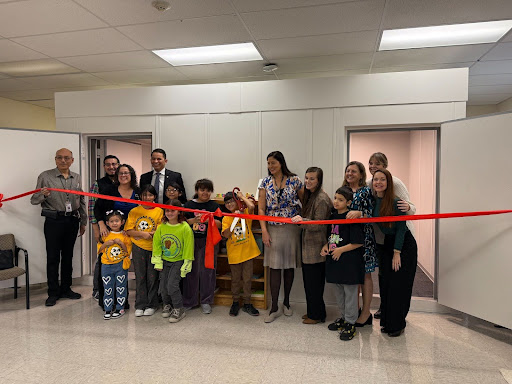
Audiology Suite Grand Opening and Ribbon Cutting

The audiology booth will assist Austin ISD's educational audiologists and deaf/hard of hearing team to support students who are part of the Austin ISD Regional Day School Program for the Deaf (RDSPD), and support all students who may be hard of hearing.

 National Speech-Language-Hearing Month Logo
Audiology Booth ribbon cutting with students and staff

Ribbon Cutting ceremony for the Audiology booth.

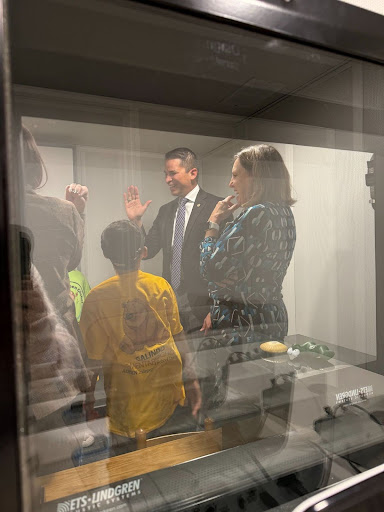
Superintendent Segura visits the Audiology Booth!

Superintendent Segura visits

the Audiology Booth!

Austin ISD has its very first audiology booth!

Tips from the Team

The following Family Tips are from Supporting Students with Disabilities at School & Home: A Guide for Teachers to Support Families and Students from the Center on Positive Behavioral Interventions & Supports (PBIS) and the National Center on Intensive Intervention (NCII). 

1. Develop, Teach, Review, Remind, and Reinforce Predictable Routines and Expectations

Ensure your home is a predictable, positive, and safe environment to support social, emotional, behavioral, and cognitive growth. 

  • Develop predictable routines that work for your family, teach those clearly, and create reminders (written schedule, pictures) 

  • Insert breaks or fun activities in the schedule as rewards for completing more challenging activities 

  • Develop positive family expectations, describe what they do (and do not) look like within each family routine, and provide reminders at the start of new or difficult routines 

  • Provide positive feedback and other rewards when children meet expectations 

  • Use positive calm redirections or corrective feedback, reminding the child what they should do, when they make mistakes or behave in ways not consistent with your expectations 

  • Provide more positive than corrective feedback (at least 5 positives for each corrective)

2. Use Efficient and Effective Instructional Strategies to Maximize Benefit

During learning times in your family schedule, set reasonable goals for what you and your child will be able to accomplish, do your best, and celebrate successes. 

  • Add academic content and practice into everyday activities in your home (e.g., involve your child in measurement during cooking, play “quiz” games during a family meal, read with your child before bed) 

  • Use effective (research-based) programs to enhance your child’s learning 

  • Consider using scripted lessons to help your child develop and maintain basic academic skills (see resources section)

3. If Your Student has More Intensive Needs, Provide Targeted or Intensive Support

To support children with more intensive support needs, try to be more intentional in your approach. Set reasonable goals, do your best, and celebrate successes. 

  • Increase the structure, predictability, and reminders of expectations and strategies 

  • If you’re able to provide targeted instruction, consult with your child’s teacher to use scripted lessons to explicitly teach skills in identified areas (e.g., reading, math, social skills), and use research-based programs that provide supplemental practice in needed areas

  • If you’re able to provide individualized instruction, follow a model (I do), lead (we do), and test (you do) format to show, practice, and provide feedback on individualized skills (e.g., asking for help, following picture sequence to complete an activity) 

  • Increase practice opportunities and provide feedback to support growth

4. Enhance Relationships Between Home and School to Support Your Student

Collaborating with your child and their teacher(s) is important for your child’s success. Help the teacher(s) understand your child’s strengths and needs, and have a positive open dialogue to anticipate and address challenges. 

  • Recognize the expertise that families and teachers bring 

  • Families know their child’s strengths and needs and know what has (and has not) worked in the past 

  • Children know what they like and what works for them 

  • Teachers have expertise in their content, instructional strategies, and what has worked with other students 

  • Talk to the teacher(s) regularly about your child’s academic, social, emotional, and behavioral progress and how you can support your child—you are a partner in your child’s education 

  • Ask your child what they see as a need and what would be helpful • Learn more about parent support and advocacy to enhance your collaboration

5. If Your Student is Not Being Successful, Ask For Help

As described in practice 4, partner with your child’s teacher(s) in implementing practices 1-3. If your child needs additional support, ask for more help from a school psychologist, social worker, counselor, or administrator in your school or district. 

  • Ask for help so you know how to correctly implement the support needed and make sure it fits into your family context 

  • With help, adjust targeted or individualized support to better meet your child’s needs 

  • With help, consider additional need areas (e.g., mental health support, functional learning needs)

Please refer to the document, Supporting Students with Disabilities at School & Home: A Guide for Teachers to Support Families and Students from the Center on Positive Behavioral Interventions & Supports (PBIS) and the National Center on Intensive Intervention (NCII), for additional information and resources on this topic.


Community Resources

Partners Resource Network Events

Do you want to be an effective advocate for your child? Partners Resource Network offers free webinars and in-person workshops across the state. Visit their website linked above to see events in English or in Spanish in your area!

Learn more at: https://prntexas.org/events/